


Separable syn/anti dinuclear Co(ii) macrocycles as robust high-performance paraCEST MRI probes

Abstract
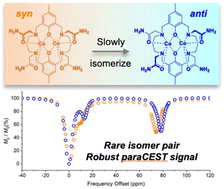
Conformational control is a powerful strategy for programming function in coordination chemistry, yet isolable isomer pairs that enable clean structure–property correlations remain uncommon for aqueous first-row transition-metal systems. Here we report a rare, separable syn/anti pair of dinuclear Co(II) complexes supported by a Robson-type macrocycle, obtained as well-defined crystalline solids and characterized by single-crystal X-ray diffraction, paramagnetic 1H NMR spectroscopy, electrochemistry, and paramagnetic chemical exchange saturation transfer (paraCEST) measurements. Time-resolved paramagnetic NMR reveals slow syn-to-anti interconversion in water (ΔG≠ (298 K) ≈ 26.0 kcal mol−1; t1/2 ≈ 16 d). Despite their distinct conformations, both isomers display outstanding paraCEST performance at 37 °C with large frequency offsets (Δω ≈ 74–79 ppm) and favorable exchange kinetics (kex ≈ 110–240 s−1) across pH 6.4–7.8, delivering up to ∼60% water-signal attenuation at 10 mM and substantial contrast even under low radiofrequency saturation fields. Importantly, strong paraCEST effects are retained in fetal bovine serum, underscoring the robustness of this platform in a protein-rich matrix. These results establish isolable dinuclear Co(II) conformational isomers as high-performance paraCEST probes that outperform the vast majority of first-row transition-metal-based complexes, while providing an experimentally tractable framework for understanding how conformation impacts MRI-relevant exchange processes in water.
 Please wait while we load your content...


