


 PLATFORM UPDATE:


Orbital engineering in single-atom catalysts: from hybridization principles to electrocatalytic design

Abstract
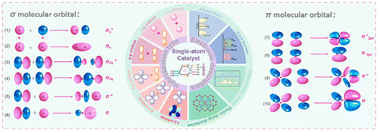
Single-atom catalysts (SACs) have emerged as a pivotal class of materials in electrocatalysis, offering unparalleled atom utilization and well-defined active sites. However, their catalytic performance is intrinsically influenced not merely by the metal identity, but also by the local coordination environment through orbital hybridization. This review systematically constructs a fundamental framework for understanding and manipulating the electronic structure of SACs through orbital engineering. This review starts by establishing the theoretical basis of key electronic descriptors, including the d-band center, work function, and projected density of states (PDOS). The discussion is then extended to the distinct regulatory roles of s, p, d and f-orbital hybridization in tailoring adsorption energetics and reaction pathways. Advanced characterization and computational techniques for probing these interactions are elaborated. Furthermore, this review highlights the frontier catalyst structure that leverages the multi-orbital synergy, such as high-entropy SACs, single-atom alloys, and ordered atomic arrays to break scaling relations and unlock novel functionalities. Finally, a perspective on future challenges and opportunities in this evolving field is provided, guiding the rational design of next-generation electrocatalysts for sustainable energy conversion.
- This article is part of the themed collection: 2026 Inorganic Chemistry Frontiers Review-type Articles
 Please wait while we load your content...


