


Terpyridine–thiophene–triphenylamine conjugated ligand design enabling green-colored, multistate electrochromic Fe(ii) metallopolymers
 *a
*a
Abstract
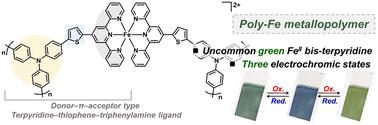
Achieving diverse and precisely controlled color outputs remains a key challenge for electrochromic materials, particularly for FeII terpyridine-based metallopolymers, which are typically limited to purple hues due to the fixed energy of FeII–terpyridine metal-to-ligand charge-transfer transitions. Here, a donor–π-acceptor terpyridine ligand incorporating a thiophene–triphenylamine (Tpy–Th–TPA) unit was employed to construct an Fe-based electrochromic metallopolymer. The [FeII(TpyThTPA)2]2+ monomer complex exhibits an uncommon green color arising from a red-shifted MLCT band combined with an intraligand charge-transfer transition band. Oxidative electropolymerization of this complex enables the direct formation of an electroactive metallopolymer film on ITO substrates. Owing to well-separated ligand- and metal-centered redox processes, the resulting FeII metallopolymer film displays three distinct and reversibly addressable electrochromic states, undergoing sequential color changes from green to blue and yellow-green. The film exhibits reversible switching, reasonable response times (tc = 2.3 s and tb = 1.9 s), a coloration efficiency of 291.6 cm2 C−1, and good cycling stability, demonstrating that rational donor–π-acceptor ligand design is an effective strategy for tailoring the optical properties of Fe metallopolymers and achieving multistate electrochromism.
 Please wait while we load your content...


