


Balancing transmetallation and CF2 α-elimination barriers in organobismuth-catalyzed olefin difluorocarbenation

Abstract
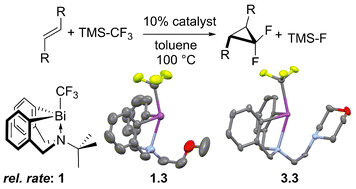
Organobismuth-catalyzed olefin difluorocarbenation is a reagent-efficient approach to 1,1-difluorocyclopropanes, requiring only near-stoichiometric amounts of TMS-CF3 due to the ability to release CF2 in a controlled manner, while allowing even the challenging transformation of electron-poor alkenes. However, slow reaction times, high reaction temperature, and high catalytic loadings represent some drawbacks of this approach. Herein, we investigate how ligand design affects the two key steps of the catalytic cycle: the CF2 α-elimination reaction and transmetallation. We show that a strong donor atom trans to the CF3 group efficiently lowers the barrier of the rate-determining step, CF2 α-elimination, and can also accelerate the transmetallation step. Transmetallation is far more sensitive to ligand effects. Notably, we found that complexes bearing tetradentate ligands exhibited improved reactivity in both catalytic steps, leading to a 3-fold improvement in performance over the original catalyst used in the reference reaction with stilbene.
 Please wait while we load your content...


