


Bi3+-doped BaMScO4 (M = Y, Gd) phosphors as multiple-mode optical thermometers for potential applications in optical thermometry and temperature imaging
 *b
and
Min
Yin
*b
*b
and
Min
Yin
*b
Abstract
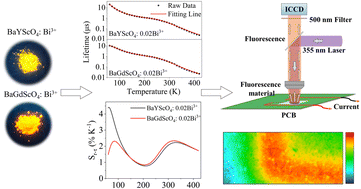
With the increasing demand for noncontact thermometry, optical thermometers have garnered intense interest. With this in view, Bi3+-doped BaYScO4 and BaGdScO4 phosphors were prepared via a high-temperature solid-state method in this work. Under near-ultraviolet excitation, the two phosphors exhibit broadband yellow and orange luminescence, respectively, originating from Bi3+–Sc3+ MMCT transitions. Their luminescence manifests a strong temperature dependence. Above 200 K, the emission intensity decreases rapidly with increasing temperature, yielding a maximum relative sensitivity (Sr) exceeding 2% for temperature sensing based on the luminescence intensity. Moreover, across the broad temperature range of 60–420 K, the fluorescence lifetime shortens markedly as the temperature increases. In terms of the temperature-dependent lifetime, the Sr value consistently remains above 0.77%. In the low-temperature region (60–210 K), the maximum Sr values are 4.40% for BaYScO4:Bi3+ and 2.31% for BaGdScO4:Bi3+. At higher temperatures (210–420 K), their maximum Sr values are 2.23% and 2.34%, respectively. Owing to the sharp lifetime decrease of BaGdScO4:0.02Bi3+ near room temperature, a temperature-sensing strategy based on a time-resolved technique is implemented. Temperature calibration is accomplished by measuring the ratio of integrated emission intensities within two specific time windows in the fluorescence decay process at different temperatures. This method results in a high performance of Sr that increased from 1.77% K−1 to 3.01% K−1 between 300 and 345 K. Finally, to validate the feasibility of this strategy, temperature imaging on a printed circuit board is successfully demonstrated using an ICCD camera coupled with a fluorescence microscope. These results collectively indicate that the fluorescence intensity and lifetime of both BaYScO4:Bi3+ and BaGdScO4:Bi3+ are highly temperature-sensitive, promising their great potential for applications in optical thermometry and thermal imaging.
 Please wait while we load your content...


