


Hydroxyl-glutarimidedioxime: a complexing reagent to strip uranium from the organic phase of P350
 a
Bijun
Liu,
*a
Xiang
Li,
a
Qingye
Zhou,
a
Chenchen
Yuan,
a
Zeng
Huang
a
and
Xingliang
Li
*a
a
Bijun
Liu,
*a
Xiang
Li,
a
Qingye
Zhou,
a
Chenchen
Yuan,
a
Zeng
Huang
a
and
Xingliang
Li
*a
Abstract
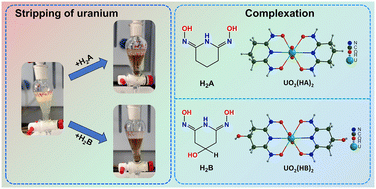
The extractant di(1-methyl-heptyl) methylphosphonate (P350) shows excellent performance in the separation of thorium and uranium; however, it poses a significant challenge for the efficient stripping of uranium(VI) from the organic phase. To address this, a hydroxyl-functionalized ligand, hydroxyl-glutarimidedioxime (H2B), was designed and synthesized by introducing a hydroxyl group onto the piperidine ring of the parent ligand glutarimidedioxime (H2A). This structural modification markedly enhanced the aqueous solubility of H2B without altering its tridentate coordination mode with uranyl. Stripping experiments confirmed that H2B enables near-quantitative recovery of uranium (∼100%), significantly outperforming both H2A and conventional alkaline stripping agents. Computational and thermodynamic studies revealed that while H2B exhibits a slightly lower binding strength to uranyl than H2A, it maintains a strong affinity and an identical coordination geometry. These findings underscore that enhancing ligand solubility through subtle molecular design is a critical strategy for optimizing uranyl separation efficiency, providing a valuable new direction for ligand development in thorium fuel cycle reprocessing.
 Please wait while we load your content...


