


AgBiS2 nanocrystal synthesis from molecular precursors: insights into the acid-catalyzed decomposition of dialkyldithiocarbamate ligands
 †a
Paul F.
Gramelspacher,
a
Anuraj S.
Kshirsagar,
a
Charles Edwin
Webster
*a
and
Sidney E.
Creutz
*a
†a
Paul F.
Gramelspacher,
a
Anuraj S.
Kshirsagar,
a
Charles Edwin
Webster
*a
and
Sidney E.
Creutz
*a
Abstract
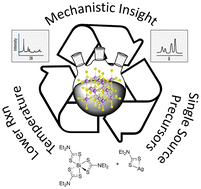
Nanocrystals of mixed metal chalcogenides such as silver bismuth sulfide (AgBiS2) offer a potential route to low-cost, environmentally friendly solar absorbers. Realizing the full potential of these materials requires a high degree of control over their properties and preparation. An understanding of the mechanisms by which molecular precursors undergo conversion and decomposition reactions during synthesis is essential for achieving this synthetic control and reproducibility. Here, we have expanded on the development of AgBiS2 nanocrystal synthesis using N,N-diethyldithiocarbamate complexes of Ag+ and Bi3+ as single-source precursors in oleylamine (OLA), establishing it as a reliable approach to high-purity and highly crystalline AgBiS2 nanomaterials. Although size tunability with this method is limited, we unexpectedly found that the addition of dodecanethiol (DDT) to the reaction mixture significantly accelerated the precursor decomposition at lower temperatures, leading to smaller size nanocrystalline domains, albeit with detrimental effects on the particle morphology. In order to understand the origin of this effect, we studied the kinetics and mechanism of precursor decomposition under different conditions using variable-temperature NMR in combination with DFT computations. We found that the use of DDT in combination with OLA promotes acid-catalyzed pathways for N,N-diethyldithiocarbamate transamidation with OLA, ultimately inducing low-temperature C–S bond cleavage. Demonstrating the advantages of this mechanistic understanding, we redesigned a new synthesis using a CS2 additive in combination with dithiocarbamate precursors which produces high-quality, quantum-confined AgBiS2 nanocrystals. In addition to new routes to size-tunable AgBiS2 nanocrystals, these studies provide potentially useful mechanistic insights about dialkyldithiocarbamate precursor conversion reactions in general, and how they can be rationally controlled.
 Please wait while we load your content...


