


Stabilized Cuδ+–OH species on Cu nanoparticles encapsulated in porous carbon nitride for electrocatalytic reduction of CO2 to ethylene
 *bd
and
Rong
Cao
abd
*bd
and
Rong
Cao
abd
Abstract
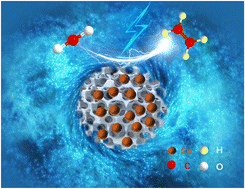
Achieving large-scale electrochemical CO2 reduction to multicarbon products with high selectivity is promising for carbon neutrality. However, the unsatisfactory multicarbon product selectivity and unclear reaction mechanisms have hindered its further development. Herein, we report a strategy that manipulates the interfacial microenvironment of Cu nanoparticles (Cu NPs) by incorporation with g-C3N4 to realize the reduction products’ shift from methane to ethylene. In situ characterization and theoretical calculations demonstrate that the formation of Cu–N bonds between Cu NPs and porous g-C3N4 creates the Cuδ+ (0 < δ < 1) species. Such Cuδ+ sites enhanced *OH (derived from water dissociation) adsorption through the formation of Cuδ+–OH intermediates. The stabilized Cuδ+–OH species lower the energy barrier for the asymmetric coupling of *CO and *CHO intermediates, steering the reaction pathway from methane to ethylene. The as-prepared Cu/200-C3N4 catalyst exhibits an exceptional ethylene selectivity (57%) even at a large current density of 600 mA cm−2 in the flow cell. This study advances our understanding of the CO2 reduction mechanism and offers an effective and general strategy for enhancing the electrocatalytic performance by regulating water dissociation.
 Please wait while we load your content...


