


A new water-soluble Ni(ii) complex as a prototype of metallodrugs to treat toxoplasmosis
 a
Renata V. M.
Freitas,
c
Eduardo da S.
Neves,
b
Christiane
Fernandes,
b
Adailton J.
Bortoluzzi,
b
Lino
Meurer,
b
Bruno
Szpoganicz,
b
Felipe F.
Moreira,
c
Pedro S.
Rodrigues,
c
Sergio H.
Seabra,
c
Renato A.
DaMatta
*c
and
Adolfo
Horn, Jr
*b
a
Renata V. M.
Freitas,
c
Eduardo da S.
Neves,
b
Christiane
Fernandes,
b
Adailton J.
Bortoluzzi,
b
Lino
Meurer,
b
Bruno
Szpoganicz,
b
Felipe F.
Moreira,
c
Pedro S.
Rodrigues,
c
Sergio H.
Seabra,
c
Renato A.
DaMatta
*c
and
Adolfo
Horn, Jr
*b
Abstract
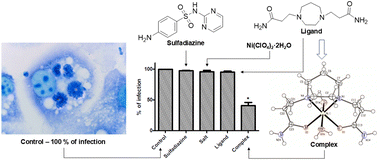
The synthesis, characterization and anti-toxoplasma activity of the new mononuclear compound [Ni(BPAH)(H2O)2](ClO4)2 are described. The complex was synthesized using the tetradentate ligand 1,4-bis(propanamide)homopiperazine (BPAH) and thoroughly characterized in the solid state (X-ray diffraction, elemental analysis, and IR) and in solution (UV-Vis, ESI-(+)-MS, and potentiometric titration). Biological investigation revealed that the complex effectively reduced the growth of Toxoplasma gondii infecting LLC-MK2 host cells, with an IC50 of 0.38 and 0.36 µmol L−1 after 24 h and 48 h of incubation, respectively, and avoided reinfection of healthy cells. Moreover, the compound demonstrated remarkable safety, exhibiting no toxicity to the host cell even at a concentration of 700 mmol L−1. Transmission electron microscopy showed that treatment with [Ni(BPAH)(H2O)2](ClO4)2 induced aberrant deformation in the parasite's conoid structure, which plays a crucial role in the cellular invasion process. The results of this treatment showed that the parasites were unable to invade host cells. This study suggests that Ni(II) compounds could be promising candidates for developing metallodrugs to treat toxoplasmosis, providing new opportunities for researchers focused on parasitic diseases.
- This article is part of the themed collection: XXI BMIC/X BMRE/ III WTBC
 Please wait while we load your content...


