


Enhanced carrier mobility-driven performance improvement in colloidal quantum dot solar cells
 d
Seong-Yong
Cho,
cd
Younghoon
Kim,
f
Sung Nam
Lim,
acj
Sohee
Jeong,
*b
Ju Young
Woo
*aci
d
Seong-Yong
Cho,
cd
Younghoon
Kim,
f
Sung Nam
Lim,
acj
Sohee
Jeong,
*b
Ju Young
Woo
*aci
Abstract
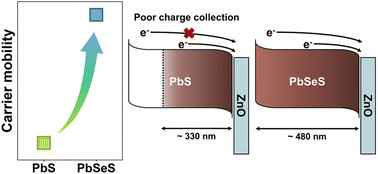
The performance of colloidal quantum dot (QD) solar cells, usually employing PbS QDs, is fundamentally limited by short carrier diffusion lengths that originate from inter-dot hopping transport. This limitation prevents the use of thick absorber layers required for complete light harvesting and suppresses power conversion efficiency. Here, we report ternary PbSeS QDs engineered to simultaneously retain a near-optimal single-junction band gap and enhance charge transport. Controlled incorporation of selenium through tailored anion precursor chemistry enables uniform alloying while maintaining absorption peaks near 930 nm, close to the Shockley–Queisser optimal band gap. Space-charge-limited current analysis reveals that ternary PbSeS QDs exhibit substantially higher carrier mobilities, showing 3.8× and 2.3× improvements in electron and hole transport compared to PbS QDs, respectively. Device studies using fully depleted architectures confirm that the mobility enhancement improves solar cell performance by suppressing carrier recombination in the depletion region. Furthermore, the extended diffusion length enables the fabrication of thicker QD absorbers, allowing PbSeS QD solar cells to maintain high efficiency even with active layers up to ∼500 nm, while conventional binary PbS QD solar cells suffer performance degradation with thick QD absorbers. The results establish ternary PbSeS QDs as a robust platform for overcoming the diffusion length bottleneck in QD photovoltaics, enabling the development of efficient devices with thicker light-absorbing layers.
- This article is part of the themed collection: 2026 Inorganic Chemistry Frontiers HOT Articles
 Please wait while we load your content...


