


 PLATFORM UPDATE:


Structural resilience in organic–inorganic stacked assemblies: sulfur-mediated self-compensating interaction and metal identity masking in group 10 dithiocarbamate cocrystals with tetracyanobenzene
 a
Sergey V.
Baykov,
b
Maxim L.
Kuznetsov,
c
Evgeny Kh.
Sadykov,
d
Pavel V.
Nikul'shin,
ef
Eugene V.
Ignatov,
bg
Nadezhda A.
Bokach
*b
and
Vadim Yu.
Kukushkin
*bg
a
Sergey V.
Baykov,
b
Maxim L.
Kuznetsov,
c
Evgeny Kh.
Sadykov,
d
Pavel V.
Nikul'shin,
ef
Eugene V.
Ignatov,
bg
Nadezhda A.
Bokach
*b
and
Vadim Yu.
Kukushkin
*bg
Abstract
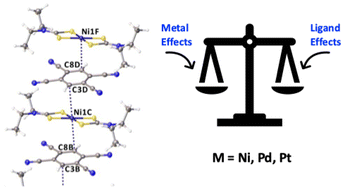
This work investigates the relative influence of metal identity versus ligand environment in determining supramolecular architecture of stacked hybrid organic–inorganic systems. We demonstrate a sulfur-mediated self-compensating mechanism that masks metal-specific electronic differences, enabling ligand-controlled assembly over conventional metal-directed organization. Through systematic investigation of group 10 metal dithiocarbamate cocrystals [M(S2CNR2)2] (M = Ni, Pd, Pt; R2 = alkyl) with 1,2,4,5-tetracyanobenzene, we reveal structural resilience—identical parallel-displaced supramolecular architectures are maintained across the entire Ni–Pd–Pt triad despite fundamental differences in dz2-orbital nucleophilicity that typically govern such assemblies. This contradicts established principles where metal variation should produce distinctly different structural outcomes. Comprehensive quantum chemical analysis using QTAIM, IGM, ETS-NOCV, and energy decomposition methods reveals that S atoms from the dithiocarbamate ligands actively neutralize inherent metal-specific properties, creating electronically equivalent {MS4} building blocks. Despite different metals, remarkably consistent interaction energies (−40.6 to −42.8 kcal mol−1) and metal contributions (13.9–15.9%) demonstrate functional equivalence in the supramolecular recognition. Our study establishes ligand-mediated metal identity masking as a design principle for creating structurally predictable metal-involving materials regardless of metal center.
 Please wait while we load your content...


