


 PLATFORM UPDATE:


Molecular insights into the role of selenoenzymes in the toxicity of methylmercury
 bc
Luigi
Messori,
d
Ewa
Bulska,
bc
Joanna
Szpunar,
a
Karinne
Miqueu
*a
and
Luisa
Ronga
*a
bc
Luigi
Messori,
d
Ewa
Bulska,
bc
Joanna
Szpunar,
a
Karinne
Miqueu
*a
and
Luisa
Ronga
*a
Abstract
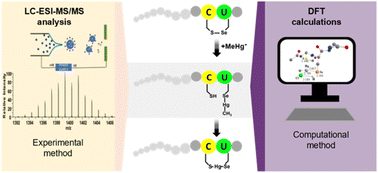
Mercury (Hg) is a toxic metal that poses a serious threat to global health. Methylmercury (MeHg), an organic compound of Hg, is among the most toxic forms of the metal. The molecular mechanisms by which methylmercury produces its toxic effects are not fully understood. However, previous studies have shown that certain selenoenzymes, which play a vital role in maintaining cellular and tissue homeostasis (e.g. thioredoxin reductase (TrxR) and glutathione peroxidase (GPx)), are strongly inhibited by methylmercury in both in vitro and in vivo studies, and are therefore probable targets of its toxicity. This study aims to gain a comprehensive mechanistic understanding of the role of selenoproteins in methylmercury toxicity by investigating their reactivity towards MeHg+ and analysing their metal-binding mode using a joint experimental and computational approach. In particular, liquid chromatography (LC) coupled to tandem electrospray mass spectrometry (ESI-MS) was employed to characterise the reactivity of methylmercury with the C-terminal dodecapeptide of TrxR1 and the full-length Gpx1. Remarkably, clear evidence of Se–Hg bond formation in GPx1 has been achieved for the first time in this study. Conversely, DFT calculations provided a rational explanation and detailed description of the underlying reaction mechanisms involving the preferential reactivity of MeHg+ towards SeCys, followed by the participation of neighboring Cys residues. These reactions lead to the formation of robust S–Hg–S(e) bridges within the investigated selenoproteins. We propose that these molecular mechanisms also operate in vivo, determining the potent inhibition of selenoenzymes by MeHg and the associated severe toxicity.
 Please wait while we load your content...


