


In situ reconstructed amorphous MOOH-enhanced NiCoP@NiFe-LDH bifunctional electrocatalyst for long durable seawater electrolysis
 *ab
and
Rong-Da
Zhao
*ab
*ab
and
Rong-Da
Zhao
*ab
Abstract
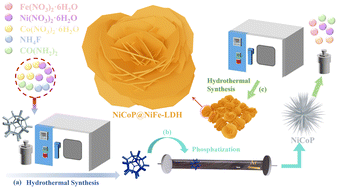
Electrocatalytic hydrogen production has garnered significant attention due to its potential for clean energy applications. However, the large-scale implementation of noble metal catalysts remains challenging owing to their high cost and low efficiency. In this work, interface-decorated NiCoP@NiFe-LDH bifunctional catalysts were successfully fabricated using convenient methods. The catalyst presents a low overpotential of −59 mV at −10 mA cm−2 for the HER and 258 mV at 50 mA cm−2 overpotential for the OER in 1 M KOH electrolyte. In situ Raman spectroscopy indicated that after the OER test, amorphous Ni-CoOOH was formed. In addition, the as-fabricated catalysts also display an excellent seawater catalytic performance with the potentials of 282 mV at 50 mA cm−2 mV and −100 mV at −10 mA cm−2 for the OER and HER, respectively. Finally, when employed as both the cathode and anode for overall seawater electrolysis, the catalyst requires only a cell voltage of 1.731 V to achieve a current density of 50 mA cm−2, exhibiting superior cycling stability. The DFT calculations reveal the origin of the excellent HER performance of the NiCoP@NiFe-LDH heterostructure. The formation of the heterointerface effectively modulates the electronic structure of the material, and through synergistic effects, significantly optimizes the hydrogen adsorption free energy (ΔGH*) to a near-ideal value. This ultimately leads to a substantial increase in the intrinsic HER catalytic activity of the material.
 Please wait while we load your content...


