


 PLATFORM UPDATE:


Stabilization of the double sandwich structure of mercury(ii) porphyrins: Hg⋯Hg⋯Hg interactions and structure–function correlation†

Abstract
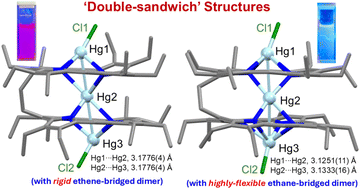
A series of stable trinuclear “double sandwich” complexes of mercury(II) porphyrins with linear Hg3 cores has been stabilized successfully utilizing both flexible and rigid porphyrin dimer frameworks. The gross structural patterns are similar: two terminal Hg(II) centers are above and below the porphyrin rings, whereas the middle Hg(II) center is sandwiched between the two rings. The mercury–nitrogen distances are quite different in the complexes. Mercurophilic interactions play a crucial role in stabilizing this unique structure, with a linear Hg⋯Hg⋯Hg unit overcoming the inherent instability arising from two coplanar aromatic (porphyrin) rings placed exactly on top of each other with eclipsed conformations, a hallmark of the double sandwich complexes reported here. Interestingly, the strongest mercurophilic interactions (with Hg⋯Hg distances of 3.1251(11) Å and 3.1333(16) Å) are observed with the highly flexible ethane-bridged porphyrin dimer. Extensive DFT calculations demonstrate that the mercurophilic interaction is evident when relativistic and dispersion effects are included and the distances are also in excellent agreement with the X-ray structures of the complexes. NBO and QTAIM analyses revealed distinct bond paths and bond critical points (BCPs) that are commonly recognized as key indicators of mercurophilic interactions. The absorption (with an MMLCT band at ∼350 nm) and photoluminescence properties of the complexes display direct correlation with the strength of the Hg⋯Hg interactions. Fluorescence decays at the blue end (related to the mercurophilic interactions) of the emission spectra are faster than those at the red end (associated with ligand emission) for all the complexes at both 298 K and 77 K.
 Please wait while we load your content...


