


 PLATFORM UPDATE:

Rational design and synthesis of imine linked porous organic polymers: a bi-faceted approach towards customizing the acid–base properties for heterogeneous catalysis
 *ab
*ab
Abstract
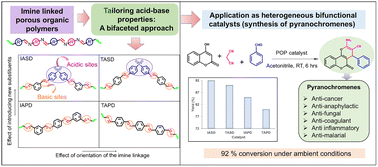
Porous organic polymers have gained significant attention due to their structural characteristics. Here, we present an investigation on the catalytic potential of POPs as heterogeneous, bifunctional catalysts for the catalytic synthesis of pyranochromenes as a model reaction. The synthetic strategy entails the incorporation of a sulfonyl functional group into a basic imine-linked polymer framework. This modification was anticipated to confer acidity to the catalyst surface. We focused on modulating the acid–base properties of the framework via two distinct methodologies: (i) changing the orientation of the imine linkage and (ii) introducing new substituents. To evaluate this notion, four structurally analogous POPs were synthesized by a one-pot solvothermal polymerization method. The obtained POPs were characterized by various spectroscopic techniques. The high crystallinity and excellent thermal stability up to 500 °C were remarkable. The surface acid–base bifunctionality was confirmed by temperature programmed desorption measurements. The catalytic performance was assessed in the one-pot, multicomponent synthesis of pyranochromenes. Various reaction parameters were subsequently optimized, providing a high yield of 92%. A strong correlation between the surface acid–base properties and catalytic activity observed justifies the requirement of such tunable acid–base catalysts that could serve as potential candidates for catalyzing multicomponent reactions.
 Please wait while we load your content...


