


 PLATFORM UPDATE:

A mild-temperature self-healing bio-based polyurethane film enabled by dual dynamic covalent bonds and segmental design
 a
and
Panfang
Lu
*a
a
and
Panfang
Lu
*a
Abstract
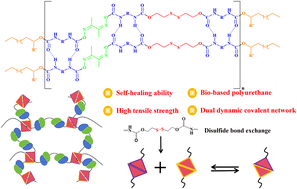
This study successfully developed a bio-based polyurethane (PU-S-D) film that combines high mechanical strength with excellent mild-temperature self-healing properties. The material was prepared by pre-polymerizing castor oil with isophorone diisocyanate (IPDI), followed by chain extension using a mixture of 2-hydroxyethyl disulfide (HED) and dimethylglyoxime (DMG) as mixed chain extenders, constructing a multi-dynamic synergistic network wherein weaker disulfide bonds afford mild-temperature self-healing, stronger oxime–urethane bonds provide robust mechanical strength, and multiple hydrogen bonds serve to reinforce and integrate these functionalities. The structure and properties of the bio-based polyurethane film were thoroughly analyzed and discussed. This bio-based polyurethane film exhibits a high gel fraction (∼90%) after more than 72 h and relatively high thermal stability (T50% > 400 °C). The glass transition temperature (Tg) of the film material is controlled near 30 °C, ensuring that it possesses sufficient molecular chain mobility at mild temperature to trigger self-healing while simultaneously maintaining excellent mechanical strength. The mechanical performance results of the film are outstanding: compared to the pure PU film, the tensile strength of the PU-S-D film increased by approximately 862% (reaching 12.4 MPa), while the elongation at break exceeded 310%. The film demonstrates remarkable self-healing performance, achieving a repair efficiency of 83% under conditions of 35 °C for 12 h. Molecular dynamics simulations and in situ infrared spectroscopy indicated that the dynamic disulfide bonds spontaneously recombine after fracture and induce the film's repair process. This research provides a strategy for developing bio-based, low-cost, high-performance materials. The developed dynamic covalent polyurethane network holds significant potential for practical applications requiring long-term durability and high reparability, such as protective coatings, high-performance adhesives, and durable composite matrices.
 Please wait while we load your content...


