


 PLATFORM UPDATE:


AIE/CPL dual-functional poly(aryl isocyanide)s synthesized using (S,S)-bis(oxazolinylphenyl)amido-ligated palladium phenylethynyl complexes: high-security anti-counterfeiting and targeted cellular imaging
 *a
*a
Abstract
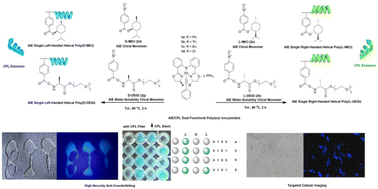
Poly(aryl isocyanide)s (PAIs) with dual aggregation-induced emission (AIE) and circularly polarized luminescence (CPL) activities have emerged as promising candidates for advanced functional materials due to their unique helical conformations, structural adjustability, and excellent optical properties. Herein, various AIE/CPL dual-functional PAIs are successfully synthesized via coordination (co)polymerization of functional aryl isocyanides catalysed by a series of air-stable (S,S)-bis(oxazolinylphenyl)amido-ligated palladium(II) phenylethynyl complexes (R2-(S,S)-BOPA)PdC![[triple bond, length as m-dash]](https://www.rsc.org/images/entities/char_e002.gif) CC6H5 (1a–1d). AIE-active moieties, chiral D/L-menthyl-ester and D/L-amino acid groups, and oligo(ethylene glycol) (OEG) segments are rationally integrated into the side chains of PAIs to endow AIE activity, CPL performance, biocompatibility, and processability. These properties of PAIs are investigated in detail. The results show that their optimal fluorescence quantum yield (ΦFL) reaches 24.1%, and the maximum absolute value of luminescence dissymmetry factor (|glum|) is 1.4 × 10⁻³. In anti-counterfeiting applications, PAI-based inks and films achieve “invisible under natural light–visible under UV irradiation” luminescence switching and unique CPL chiral signals, showing excellent anti-counterfeiting security and stability. In cellular imaging, OEG-modified PAIs realize precise subcellular targeting imaging, accompanied by low cytotoxicity and good in vivo biocompatibility. This work provides a facile synthetic strategy for AIE/CPL dual-functional PAIs, clarifies the structure–property–application relationship, and expands their practical applications in high-security anti-counterfeiting and biological imaging.
CC6H5 (1a–1d). AIE-active moieties, chiral D/L-menthyl-ester and D/L-amino acid groups, and oligo(ethylene glycol) (OEG) segments are rationally integrated into the side chains of PAIs to endow AIE activity, CPL performance, biocompatibility, and processability. These properties of PAIs are investigated in detail. The results show that their optimal fluorescence quantum yield (ΦFL) reaches 24.1%, and the maximum absolute value of luminescence dissymmetry factor (|glum|) is 1.4 × 10⁻³. In anti-counterfeiting applications, PAI-based inks and films achieve “invisible under natural light–visible under UV irradiation” luminescence switching and unique CPL chiral signals, showing excellent anti-counterfeiting security and stability. In cellular imaging, OEG-modified PAIs realize precise subcellular targeting imaging, accompanied by low cytotoxicity and good in vivo biocompatibility. This work provides a facile synthetic strategy for AIE/CPL dual-functional PAIs, clarifies the structure–property–application relationship, and expands their practical applications in high-security anti-counterfeiting and biological imaging.
 Please wait while we load your content...


