


Covalent organic frameworks: synthesis, and biological and chemical sensing
 *a
*a
Abstract
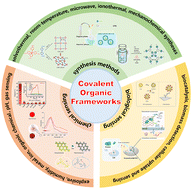
Covalent organic frameworks (COFs), a class of porous crystalline materials with designable structures and tuneable properties, have attracted extensive attention in the field of materials science. The exceptional properties of COFs, particularly their high surface area, tuneable pore size, and functionalizable surfaces, make them ideal platforms for sensing applications. The rational design and synthesis of COFs are fundamental to unlocking their full potential in various applications. This review comprehensively summarizes the research progress of COFs, focusing on their common synthesis methods, applications in biosensing and chemical sensing, and current challenges and future perspectives. As for synthesis, two-dimensional COFs are prepared via solvothermal, room-temperature, or microwave-assisted methods (with strengths in crystallinity, mild conditions, and efficiency), while three-dimensional COFs use solvothermal, ionothermal, or mechanochemical approaches (expanding the synthesis scope and enabling large-scale production). In applications, COFs excel in biosensing (enzyme immobilization, protein/nucleic acid detection, biomarker recognition, cellular sensing) and chemical sensing (explosives, metal ions, gases, etc.) due to their high specific surface area, adjustable pores, and chemical stability. Current challenges include high synthesis cost and poor environmental stability, and future work will focus on optimizing large-scale synthesis, enhancing stability, and developing intelligent sensing systems. This review provides a concise reference for further research and application of COFs.
 Please wait while we load your content...


