Lewis acid-mediated formamidation employing carbohydrates as synthons

Abstract

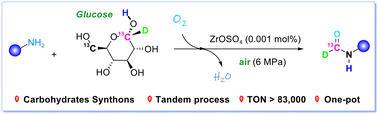
A practical formamidation using air as the sole oxidant and a Lewis acid as the catalyst, without the need for exogenous oxidants or stoichiometric additives, was developed. This catalytic system efficiently achieved N-formamidation of glucose with various amines under mild conditions, affording high yields of diverse N-formamides and a turnover number of 83 213, the highest value reported to date for analogous reactions. Isotope labeling experiments (D-, 13C6-glucose, and 18O2) confirmed that the carbon originated from glucose C1, the formyl hydrogen from the C–H bonds at glucose C2–C6, the N–H hydrogen from glucose hydroxyl groups, and the oxygen from O2. The mechanistic study reveals that the Lewis acid not only promotes the dehydration–isomerization of glucose but also accelerates its selective oxidation by air, thereby driving the condensation–oxidation cascade reaction efficiently.

Graphical abstract: Lewis acid-mediated formamidation employing carbohydrates as synthons

Supplementary files

Transparent peer review

To support increased transparency, we offer authors the option to publish the peer review history alongside their article.

View this article’s peer review history

Article information

Article type
Communication
Submitted
30 Jan 2026
Accepted
13 Mar 2026
First published
14 Mar 2026

Org. Biomol. Chem., 2026, Advance Article

Lewis acid-mediated formamidation employing carbohydrates as synthons

Y. Li, W. Zhang, Z. Zhang, X. Li, Q. Liang, Y. Liu and G. Zhang, Org. Biomol. Chem., 2026, Advance Article , DOI: 10.1039/D6OB00174B

To request permission to reproduce material from this article, please go to the Copyright Clearance Center request page.

If you are an author contributing to an RSC publication, you do not need to request permission provided correct acknowledgement is given.

If you are the author of this article, you do not need to request permission to reproduce figures and diagrams provided correct acknowledgement is given. If you want to reproduce the whole article in a third-party publication (excluding your thesis/dissertation for which permission is not required) please go to the Copyright Clearance Center request page.

Read more about how to correctly acknowledge RSC content.

Social activity

Spotlight

Advertisements