


Synthesis and biological study of benzothiophene-fused azaenediyne hybrids as potential anticancer agents

Abstract
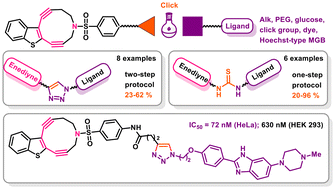
Enediyne antibiotics are strong cytotoxic DNA damaging agents with a radical mechanism of action. Here, we report on the synthesis of enediyne analogues using click chemistry as a mild and efficient tool for late-stage modification of the enediyne core. Azaenediyne fused to benzothiophene, which is stable at room temperature while being reactive in the Bergman cyclisation at 37 °C, was chosen as the parent enediyne scaffold. Two approaches were developed for the construction of hybrid molecules by click reactions: the conjugation of the key enediyne with a terminal triple bond handle and various azido-ligands by CuAAC, and an “amine-to-isothiocyanate” addition for the NCS enediyne. While CuAAC required a two-step protocol starting from a Co-protected enediyne, the “amine-to-NCS” addition approach was suitable for the unprotected NCS enediyne directly. Both approaches were successfully applied to synthesise a library of enediyne-containing hybrid molecules with triazole or thiourea linkers. Attaching a Hoechst-like MGB ligand was found to be the most promising strategy for achieving a nanomolar level of enediyne hybrid cytotoxicity. The triazole-containing Hoechst hybrid, which has been proven to localise intracellularly in the nucleus and to be selective for the HeLa cancer cell line, is considered the best candidate for further anticancer drug development.
 Please wait while we load your content...


