


 PLATFORM UPDATE:


Engineered MXenes as analytical tools for the health risk assessment of heavy metals

Abstract
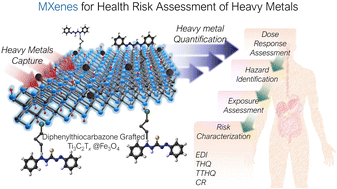
Two-dimensional MXenes are attractive materials because of their metallic conductivity, abundant surface terminations, and high aspect ratio, which can be coupled with organic molecules and magnetic structures to produce multifunctional architectures. Here, we engineered a diphenylthiocarbazone-grafted magnetic MXene, DTZ-Ti3C2@Fe3O4, through a stepwise synthesis of magnetic nanoparticles on Ti3C2 nanosheets and subsequent grafting of diphenylthiocarbazone covalently onto surface functional groups. This route yielded a hierarchically structured 2D hybrid, in which (i) Ti3C2 provided an extended, mechanically strong active scaffold, (ii) there were well-dispersed magnetic domains without shielding the MXene surface, and (iii) the immobilized diphenylthiocarbazone moieties were present as densely packed, multidentate soft-donor (N,S) chelation sites. This structure was used as an analytical tool to investigate the health risk assessment of heavy metal consumption. Under optimized conditions and acceptable figures of merit (detection limits of 0.085 ng mL−1 (Cd2+) and 0.87 ng mL−1 (Pb2+) with linear ranges of 0.3–40 µg L−1 and 3–80 µg L−1 and a preconcentration factor (PF) of 100), the concentration of heavy metals in food samples was quantified at trace levels and was directly used to calculate the Estimated Daily Intake (EDI), Target Hazard Quotient (THQ), Total Target Hazard Quotient (TTHQ), and lifetime Cancer Risk (CR) using body-weight and consumption-rate scenarios. The results showed TTHQ < 1 and CR < 1 × 10⁻⁴ for Cd and Pb ions in the analyzed food samples. To the best of our knowledge, this study reports the first covalently grafted diphenylthiocarbazone-magnetic MXene tailored specifically for the trace-metal detection and quantitative health risk assessment of heavy metals and food safety evaluation. This report demonstrates that MXenes can serve as a practical analytical platform for population-relevant risk assessment and not merely trace detection.
 Please wait while we load your content...


