



Organic–inorganic hybrid p–n junction composite for high-performance carbon monoxide sensing and mechanistic understanding using in situ Raman spectroscopy
 ab
and
P.
Tamilarasan
*ab
ab
and
P.
Tamilarasan
*ab
Abstract
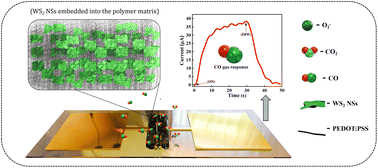
In this study, we present a novel organic–inorganic p–n heterojunction nanocomposite comprising tungsten disulfide nanosheets (WS2 NSs) and poly(3,4-ethylenedioxythiophene)-poly(styrenesulfonate) (PEDOT:PSS) for an ultra-sensitive room-temperature carbon monoxide (CO) gas sensor and its mechanistic understanding using in situ Raman spectroscopy. The hybrid nanocomposite was synthesised by ultrasonic exfoliation of WS2 NSs, followed by dispersing in the PEDOT:PSS matrix. A chemiresistive sensor, fabricated using this nanocomposite, exhibited an outstanding linear response (R2 = 0.997) across a CO gas concentration range of 1 to 600 ppm with a sensitivity of 0.91 μA ppm−1 at room temperature. At a concentration of 25 ppm, the sensor demonstrated excellent repeatability, with an impressive response (5.03 s) and recovery (8.52 s) time, clearly outperforming many commercial sensors. Notably, in situ Raman spectroscopy was employed to elucidate the sensing mechanism, revealing real-time molecular-level interaction and charge transfer dynamics at the heterojunction, thereby providing direct experimental support for the proposed mechanism. This work provides a solid foundation for developing next-generation, energy-efficient room temperature gas-sensing technologies with broad practical implications.
 Please wait while we load your content...


