


 PLATFORM UPDATE:


Engineered Co3O4 nanoboxes boost luminol chemiluminescence for selective Mn2+ sensing
 ab
Tadele
Eticha,
ab
Ala'a Mhmoued Abdllh
Alboull,
ab
Muhammad Rehan Hasan Shah
Gilani,
c
Fathimath
Abbas,
ab
Jiyang
Liu,
ab
Baohua
Lou
*a
and
Guobao
Xu
*ab
ab
Tadele
Eticha,
ab
Ala'a Mhmoued Abdllh
Alboull,
ab
Muhammad Rehan Hasan Shah
Gilani,
c
Fathimath
Abbas,
ab
Jiyang
Liu,
ab
Baohua
Lou
*a
and
Guobao
Xu
*ab
Abstract
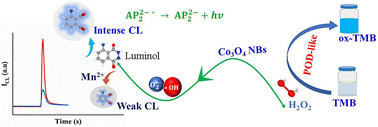
Chemiluminescence (CL) is a powerful analytical tool that has gained increasing interest in various fields due to its rapid response, simplicity, cost-effectiveness, and higher sensitivity compared to traditional complex methods for detecting trace toxic metals. The traditional luminol/H2O2 CL method suffers from low emission efficiency. As a result, the synthesis of nanozymes as co-reaction accelerators has attracted increasing attention to improve CL sensitivity. Spinel-type oxides have been used in many fields because of their cost-effectiveness, excellent catalytic performance, and eco-friendliness; however, they have seldom been used in CL. Herein, a simple chemical etching method of a self-templating ZIF-67 nanocube MOF precursor using tannic acid, followed by thermal annealing, was employed to synthesize Co3O4 nanoboxes (NBs). The Co3O4 NBs showed peroxidase-like activity and boosted the luminol/H2O2 CL by a factor of 670. The improved catalytic efficiency is attributed to increased H2O2 adsorption on the confined surfaces of Co3O4 NBs, generating more reactive oxygen species radicals and significantly enhanced luminol/H2O2 CL signals. Moreover, Mn2+ remarkably quenched CL, enabling highly sensitive Mn2+ detection with a wide linear range from 50 nM to 5 µM and a limit of detection as low as 2.5 nM.
 Please wait while we load your content...


