


 PLATFORM UPDATE:


Expanding the applicability of a multicomponent nano-quantitative structure-property relationships approach from hard to soft nanomaterials: predicting liposome stability

Abstract
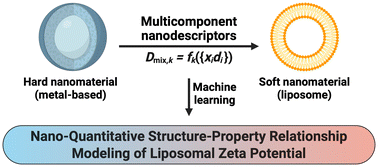
Liposomes are among the most widely used nanocarriers owing to their high biocompatibility and biodegradability, with extensive applications in drug delivery, vaccine development, nucleic acid transport, diagnostic imaging, and dermal therapy. Although liposomal nanoformulations are versatile, their development is greatly hampered by inherent complexity and the sensitivity of their physicochemical properties to the preparation methods used. Predictive, data-driven strategies that quantitatively link molecular structure to physicochemical behavior are therefore essential for overcoming inefficient trial-and-error experimentation and enabling the rational design and application of liposomal nanocarriers. In this study, we adapt a computational methodological workflow originally developed for hard multicomponent nanomaterials to soft nano-mixtures (i.e., from metal-based to liposomes). To this end, eight mathematical formulations were employed to calculate complex nanodescriptors describing liposomes composed of multiple lipids at defined molar fractions (covering 18 different lipid types). These nanodescriptors were combined with a genetic algorithm and three machine learning methods, i.e., k-nearest neighbors, support vector regression, and kernel-weighted local polynomial regression, to develop nano-quantitative structure–property relationship models for predicting liposomal zeta potential, a key indicator of colloidal stability. Among all models, the combination of square-root-fraction weighted mean nanodescriptor and k-nearest neighbors achieved the highest performance (R2 = 0.919, RMSEC = 10.157, Q2CVloo = 0.876, RMSECVloo = 12.572, Q2Ext = 0.854, RMSEExt = 12.046), accurately capturing the complex relationships between liposomal molecular features and their zeta potential. Permutation importance analysis revealed that liposomal zeta potential depends on interfacial surface characteristics (especially the extent of highly electrotopological regions), lipophilicity, charge distribution, and overall molecular complexity. Here, we demonstrate for the first time that a multicomponent nanodescriptor methodology can be successfully transferred from hard to soft nanomaterials, establishing a computational framework for the rational design of stable liposomal nanocarriers. The proposed approach provides a foundation for expanding the modeling of multicomponent soft nano-mixtures to other nanosystems relevant to biomedical applications.
 Please wait while we load your content...


