


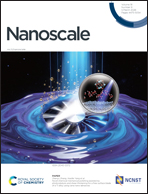
Liquid crystalline nanoconfined growth of PANI on rGO for enhanced electrochemical glucose sensing

Abstract
We report here a new strategy for the successful synthesis of a hybrid 2D nanocomposite via the in situ functionalization of graphene oxide (GO) with aniline monomers in a bi-solvent swollen liquid crystalline lamellar mesophase (SLCLM) nanoreactor. The synthesized nanocomposite product revealed possible simultaneous reactions at the edge and basal plane of GO. A mechanism for the transformation via simultaneous nucleophilic attack and spontaneous polymerization, forming a reduced graphene oxide–polyaniline (rGO–PANI) nanocomposite, is proposed. The multistep plausible reaction mechanism for the functionalization of the GO edge –COOH group is achieved by successful synthesis, followed by isolation and characterization of the N-phenyl anthranilic acid derivative as an intermediate product. Furthermore, the detection of CO2 evolution as a by-product during the reaction complements the plausible mechanism for the incorporation of (–C![[triple bond, length as m-dash]](https://www.rsc.org/images/entities/char_e002.gif) C–) graphyne-type edges and formation of new –C–N– and O–H bonds in the rGO–PANI nanocomposite. These results are supported by FT-IR, Raman, XPS, SAXS, and 13C NMR spectroscopy analyses. A reduced graphene oxide–polyaniline (rGO–PANI) modified glassy carbon electrode was developed for glucose sensing, exhibiting a wide linear range (0.554–10 µM), low detection limit (50 pM), and high sensitivity (372 660 µA mM−1 cm−2). The sensor demonstrated excellent selectivity against common interferents (ascorbic acid, uric acid, and dopamine), reproducibility (RSD < 5%), and stability over 10 000 s with minimal signal loss. The detection of glucose from human metabolites, such as urine and sweat, achieved 98–100% recoveries for spiked glucose, confirming its practical applicability. These results establish rGO–PANI as a robust platform for sensitive and selective glucose detection.
C–) graphyne-type edges and formation of new –C–N– and O–H bonds in the rGO–PANI nanocomposite. These results are supported by FT-IR, Raman, XPS, SAXS, and 13C NMR spectroscopy analyses. A reduced graphene oxide–polyaniline (rGO–PANI) modified glassy carbon electrode was developed for glucose sensing, exhibiting a wide linear range (0.554–10 µM), low detection limit (50 pM), and high sensitivity (372 660 µA mM−1 cm−2). The sensor demonstrated excellent selectivity against common interferents (ascorbic acid, uric acid, and dopamine), reproducibility (RSD < 5%), and stability over 10 000 s with minimal signal loss. The detection of glucose from human metabolites, such as urine and sweat, achieved 98–100% recoveries for spiked glucose, confirming its practical applicability. These results establish rGO–PANI as a robust platform for sensitive and selective glucose detection.

 Please wait while we load your content...


