


 PLATFORM UPDATE:


W2N3 nanodot/2D C3N4 heterostructures with interfacial covalent bonding toward Pt-free photocatalytic hydrogen evolution

Abstract
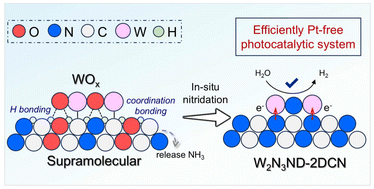
Graphitic carbon nitride is a promising photocatalyst for hydrogen evolution, but its performance is severely limited by rapid carrier recombination and the reliance on noble-metal (e.g., Pt) cocatalysts. To address this challenge, we develop a supramolecular assembly strategy enabling in situ growth of ultra-small tungsten nitride (W2N3) nanodots (∼5 nm) on 2D atomic-layered carbon nitride (W2N3ND–2DCN). This approach leverages hydrogen bonding and coordination interactions between supramolecular precursors to suppress metal agglomeration and enable low-temperature in situ nitridation, while forming strong interfacial covalent bonds between W2N3 and 2D C3N4. Systematic characterization and density functional theory calculations reveal that the interfacial bonding accelerates charge transfer, suppresses carrier recombination, and optimizes the hydrogen adsorption free energy ( ). Coupled with a high specific surface area (124 m2 g−1), W2N3ND–2DCN achieves an exceptional hydrogen evolution rate of 1785 μmol h−1 g−1 under visible light, which is comparable to the Pt-decorated benchmark (1694 μmol h−1 g−1). This work provides a feasible route to high-performance Pt-free photocatalysts for sustainable hydrogen production.
- This article is part of the themed collection: Nanoscale 2026 Emerging Investigators
 Please wait while we load your content...


