


Synthesis and modification of UiO-66(Ce) for adsorptive removal of methylene blue and Cu(ii) ions
 *ab
*ab
Abstract
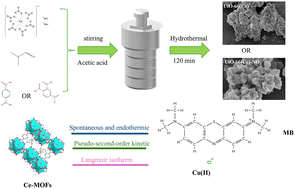
UiO-66(Ce) exhibits a high specific surface area with excellent adsorption properties and ease of functionalization, leading to its broad application in catalytic and adsorption processes. Herein, UiO-66(Ce) was synthesized and functionalized with nitro (–NO2) and amino (–NH2) groups via a one-step hydrothermal method. The effects of synthesis parameters (e.g., hydrothermal time, temperature, and the addition of acetic acid) and functionalization on the adsorptive removal of methylene blue (MB) and Cu(II) ions from aqueous solutions were systematically investigated. The hydrothermal temperature proved to be paramount for achieving phase-pure UiO-66(Ce), and the introduction of acetic acid was critical in tailoring its rough microstructure and, consequently, its adsorption performance. The superior adsorption capacity of –NO2-modified UiO-66(Ce) (191 mg g−1 for MB and 208.68 mg g−1 for Cu(II)) and the excellent fit of the pseudo-second-order kinetic and Langmuir isotherm models collectively indicate a highly effective, spontaneous, and endothermic chemisorption process. With regard to recyclability and economic cost, –NO2-modified UiO-66(Ce) also exhibits significant advantages. In general, this study demonstrates that UiO-66(Ce)-NO2 is a highly promising material for removing MB and Cu(II) from contaminated water.
 Please wait while we load your content...


