Enhancing Crystallization and Mechanical Properties of PET Polyester Using Functionalized Carbon Nanotubes

Abstract

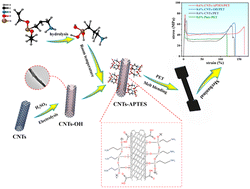
Carbon nanotubes (CNTs) demonstrate considerable potential as crystallization-enhancing materials for polyethylene terephthalate (PET); however, their effectiveness is frequently constrained by weak interfacial bonding, which results in inefficient load transfer and premature crack propagation. To mitigate this issue, this study introduces a novel preparation method that involves the construction of hydroxyl active sites on CNTs surfaces through electrochemical processes while maintaining electrode performance. This is followed by amination modification of CNTs utilizing an APTES/ethanol system, enabling them to function as efficient nucleating agents. This innovative strategy effectively addresses the limitations of traditional stepwise processes, reducing reaction time by 90%. At a filler loading of 0.6 wt%, the prepared PET composite exhibited significant enhancements in both crystallization and mechanical properties: the tensile strength increased from 53.13 MPa to 78.8 MPa, the elongation at break reached 168%, and the crystallization half-time was reduced by 38.8%. This study presents an effective solution for leveraging functionalized carbon nanotubes as nucleating agents to improve the crystallization and mechanical properties of PET polyester.

Supplementary files

Transparent peer review

To support increased transparency, we offer authors the option to publish the peer review history alongside their article.

View this article’s peer review history

Article information

Article type
Paper
Submitted
26 Dec 2025
Accepted
18 Mar 2026
First published
14 Apr 2026

Nanoscale, 2026, Accepted Manuscript

Enhancing Crystallization and Mechanical Properties of PET Polyester Using Functionalized Carbon Nanotubes

P. Zhang, Y. Wang, M. Zhang, L. Huang, K. Li, F. Li, W. Wang and J. Tang, Nanoscale, 2026, Accepted Manuscript , DOI: 10.1039/D5NR05456G

To request permission to reproduce material from this article, please go to the Copyright Clearance Center request page.

If you are an author contributing to an RSC publication, you do not need to request permission provided correct acknowledgement is given.

If you are the author of this article, you do not need to request permission to reproduce figures and diagrams provided correct acknowledgement is given. If you want to reproduce the whole article in a third-party publication (excluding your thesis/dissertation for which permission is not required) please go to the Copyright Clearance Center request page.

Read more about how to correctly acknowledge RSC content.

Social activity

Spotlight

Advertisements