


 PLATFORM UPDATE:


Multi-center bonding and structural integrity in M6M8B60 (M = Y, La, and Lu) metallo-borospherenes

Abstract
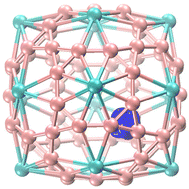
Recent experimental discoveries of metallo-borospherenes, La3B18−/Tb3B18−, revealed boron's capacity to form fullerene-like cage architectures, representing a significant advance in metallo-borospherene chemistry. Inspired by these findings, highly symmetric cage-like structures, M6M8B60 (M = Y, La, and Lu), have been proposed via first-principles calculations, where metal atoms are embedded on the cage surface. The M6M8B60 cage, unlike the La3B18−/Tb3B18− clusters, are constructed via a mixed-unit, topology-driven strategy involving six M©B8 and eight M©B9 motifs. This design does not represent a simple size expansion from smaller boron cages, but instead establishes a new cage topology featuring a larger cavity, higher symmetry, and a highly delocalized multi-center bonding network. Binary system investigations further reveal negligible electronic overlap between neighboring M6M8B60 units, confirming that each cluster can maintain its molecular integrity and exist as a stable, independent entity. Electronic structure analysis uncovers 111 uniformly distributed multi-center two-electron bonds, which underpin the exceptional stability and delocalized bonding characteristics of these metallo-borospherenes. Moreover, the robust cage of Y6Y8B60 provides a versatile host for encapsulating various atoms and small molecules (Eu, CH4, CO, H2, and HF). Encapsulation of the Eu atom notably modulates the cage's properties, yielding the endohedral complex Eu@Y6Y8B60 (Isomer I) with a magnetic moment of 7μB localized on the Eu center. The electrostatic interaction and weakly bound Eu–cage interaction highlight the tunable host–guest behavior of this system. These results expand the structural and electronic diversity of metallo-borospherenes and provide valuable insights into designing large, multifunctional boron-based nanocages with tailored electronic and magnetic properties.
- This article is part of the themed collection: Nanoscale Covers
 Please wait while we load your content...


