


 PLATFORM UPDATE:


Two-dimensional Mo3N2 MXene as a competitive-capacity and metallic anode for lithium-ion batteries
 ab
ab
Abstract
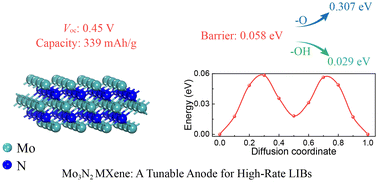
This study employs first-principles calculations to systematically investigate the electrochemical performance of the two-dimensional MXene material Mo3N2 as an anode for lithium-ion batteries, with a focus on the effects of surface functional groups (–O and –OH) and Mo vacancies. The results show that pristine Mo3N2 exhibits intrinsic metallicity, a low Li-ion diffusion barrier (0.058 eV), a theoretical capacity of 339 mAh g−1, and a suitable average open-circuit voltage of 0.45 V. However, surface functionalization significantly alters these properties: –O termination increases the diffusion barrier to 0.307 eV, while –OH reduces it to 0.029 eV; the capacity decreases to 308 mAh g−1 for Mo3N2O2 and 191 mAh g−1 for Mo3N2(OH)2. Mo vacancies are found to be easily formed (formation energy: −1.08 eV) and they create a strong trapping effect that substantially hinders Li-ion diffusion. These findings reveal that the electrochemical performance of Mo3N2 is highly tunable by surface chemistry, and optimization requires careful control of termination groups and defect structures.
 Please wait while we load your content...


