


Band structure engineering in porous g-C3N4via tailoring surface carbon for enhanced photocatalytic hydrogen evolution

Abstract
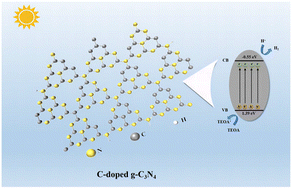
Atomic-level regulation of graphitic carbon nitride (g-C3N4) is a promising approach to enhance its inherent photocatalytic performance by optimizing the electronic band structure and improving charge separation. Herein, we developed a novel strategy for synthesizing surface-carbon-modified porous ultrathin g-C3N4 nanosheets via a chemical vapor deposition (CVD) process. This method utilizes the endogenous gases from the pyrolysis of polyacrylonitrile (PAN) to simultaneously act as a carbon source for surface deposition and as an etchant to exfoliate bulk g-C3N4 into ultrathin nanosheets. By simply adjusting the CVD temperature, the degree of carbon modification was precisely controlled. The optimal sample (CNP550) exhibits a substantially increased specific surface area of 378.0 m2 g−1 and a large pore volume of 8.6 cm3 g−1. Benefiting from this unique structure and the carbon modification, the bandgap of g-C3N4 was narrowed from 2.87 eV to 1.94 eV, while the conduction band was shifted to a higher energy. These electronic modifications collectively led to a substantial enhancement in electron–hole separation efficiency. As a result, the CNP550 sample achieved an outstanding photocatalytic hydrogen evolution rate of 688.2 μmol g−1 h−1 under visible light, which is 7.8 times higher than that of bulk g-C3N4, along with excellent long-term stability. This work offers a novel synergistic strategy for carbon doping and nanostructure engineering of ultrathin g-C3N4 nanosheets, providing an effective approach for bandgap tuning and the construction of high-performance photocatalysts for solar energy conversion.
- This article is part of the themed collection: Nanoscale 2026 Emerging Investigators
 Please wait while we load your content...


