


Anti-interference bimodule biosensors with Au/Cu2O hollow spheres for accurate detection of uric acid in human serum

Abstract
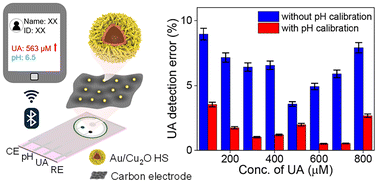
The development of portable and cost-effective biosensors for uric acid (UA) monitoring is crucial for point-of-care diagnostics, yet remains challenging due to complex biological interferences. Herein, we present a flexible bimodule biosensor fabricated on a polyethylene terephthalate (PET) substrate for simultaneous UA and pH detection. The UA sensing module utilizes screen-printed electrodes (SPEs) modified with gold nanospike-decorated cuprous oxide hollow spheres (Au/Cu2O HS), enabling highly sensitive detection of UA with an ultralow detection limit of 329 nM. An independent pH module provides real-time calibration, effectively correcting signal fluctuations caused by interferents such as ascorbic acid (AA). By applying a custom calibration algorithm, the average UA detection error in phosphate-buffered saline (PBS) containing high concentrations of AA was reduced from 6.43% to 1.02%. Furthermore, the system demonstrated reliable UA detection in human serum, highlighting its strong potential for practical diagnostic applications.
 Please wait while we load your content...


