Distinction of antioxidants using a three-channel colorimetric sensor array constructed with a bimetallic FeCo nanozyme

Abstract

The antioxidant content in food is related to the dietary safety of consumers. In this context, two-dimensional (2D) iron/cobalt metal nanosheets (Fe/Co NSs) have been synthesized through the synergistic self-assembly reaction of Fe3+/Co2+ with terephthalic acid. These Fe/Co NSs exhibit excellent peroxidase-like activities. Based on the nanozyme property of Fe/Co NSs, a three-channel sensor array has been constructed using 3,3′,5,5′-tetramethylbenzidine (TMB) as the colorimetric substrate and three wavelengths (370, 456, and 654 nm) as the array's channels, enabling distinct absorbance response signals for the identification of five antioxidants with 100% accuracy. The sensor array can accurately detect five antioxidants in the range of 100 nM–100 μM, achieving accurate quantitative analysis. The sensor array also has excellent anti-interference ability toward other interferents, even at high concentrations. These abilities endow the sensor array with great potential for discrimination of blind and actual antioxidant samples.
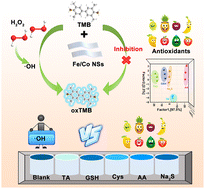
Graphical abstract: Distinction of antioxidants using a three-channel colorimetric sensor array constructed with a bimetallic FeCo nanozyme

Supplementary files

Transparent peer review

To support increased transparency, we offer authors the option to publish the peer review history alongside their article.

View this article’s peer review history

Article information

Article type
Paper
Submitted
09 Oct 2025
Accepted
30 Nov 2025
First published
01 Dec 2025

Nanoscale, 2026, Advance Article

Distinction of antioxidants using a three-channel colorimetric sensor array constructed with a bimetallic FeCo nanozyme

L. Li, J. Zhao and Z. Chen, Nanoscale, 2026, Advance Article , DOI: 10.1039/D5NR04256A

To request permission to reproduce material from this article, please go to the Copyright Clearance Center request page.

If you are an author contributing to an RSC publication, you do not need to request permission provided correct acknowledgement is given.

If you are the author of this article, you do not need to request permission to reproduce figures and diagrams provided correct acknowledgement is given. If you want to reproduce the whole article in a third-party publication (excluding your thesis/dissertation for which permission is not required) please go to the Copyright Clearance Center request page.

Read more about how to correctly acknowledge RSC content.

Social activity

Spotlight

Advertisements