


Fine-tuning and electronic modulation of AuPdCu nanoflowers assembled with nanowires for robust ethanol oxidation reaction performance
 *a
*a
Abstract
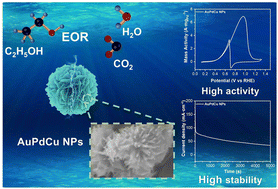
Direct ethanol fuel cells (DEFCs) have attracted much attention due to their high energy density and readily available fuels, but their development is limited by the poor performance of anode catalysts. Although Pd-based catalysts exhibit excellent activity in the ethanol oxidation reaction (EOR), their active site density is low, and they are easily poisoned by strong adsorption of CO* intermediates. Herein, we designed unique nanoflower-like AuPdCu nanoparticles (NPs) through a liquid-phase reflux process. Compared to conventional nanoflowers, their petals consist of numerous converging nanowires. Furthermore, the electronic structure of Pd-based catalysts can be finely tuned by alloying with Au and Cu to regulate the adsorption and desorption of CO* intermediates. As a result, the designed AuPdCu NPs demonstrated exceptional catalytic activity for the EOR, achieving a mass activity (MA) of 6.89 A mgPd−1, surpassing commercial Pd/C and some recently reported catalysts. After a 5000 s chronoamperometric stability test, they maintained a current density of 34.81 mA cm−2. Density functional theory (DFT) calculations confirm that the adsorption of the CH3CO* intermediate on AuPdCu NPs is enhanced, thereby promoting the EOR process along the C1 pathway. This ternary metal fine-tuning alloying approach presents a viable route for fabricating highly active and durable EOR materials.
 Please wait while we load your content...


