


Dynamic modulation of ionic and electronic pathways in flexible SnS2-based interdigitated solid-state supercapacitors
 *bc
and
Helen Annal
Therese
*a
*bc
and
Helen Annal
Therese
*a
Abstract
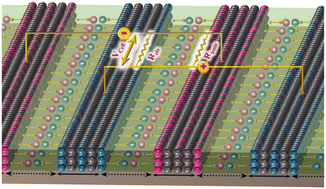
The interdigitated super capacitor (ISC) offers a high-efficiency energy storage approach, utilizing narrowly spaced electrode fingers to lower ionic resistance and promote faster ion transport at the electrode–electrolyte interface. A symmetric flexible device was fabricated using electron beam evaporation, where SnS2 thin films deposited by physical vapor deposition (PVD) served as active electrodes. At a sweep rate of 5 mV s−1, the ISC demonstrated pronounced pseudocapacitive behavior, delivering a high volumetric capacitance of 1129.1 F cm−3. We introduced and correlated the key transport properties, including the average ionic transference number (![[t with combining macron]](https://www.rsc.org/images/entities/i_char_0074_0304.gif) ion), ionic conductivity (σAC), electron transfer characteristics (k0 and D0), charge carrier mobility and charge carrier density (μc and nc), analyzed under OFF, ON, and VD-state conditions. The ISC showed superior electrochemical characteristics notable values such as σAC ≈ 6.788 × 10⁻⁴ S cm−1, D0 ≈ 3.635 × 10⁻¹¹ cm2 s−1, and μc ≈ 65.11 cm2 V−1 s−1. Its enhanced energy delivery capacity was further validated by powering red LEDs within a 4 V circuit, underscoring its suitability for integration into flexible and compact energy storage technologies.
ion), ionic conductivity (σAC), electron transfer characteristics (k0 and D0), charge carrier mobility and charge carrier density (μc and nc), analyzed under OFF, ON, and VD-state conditions. The ISC showed superior electrochemical characteristics notable values such as σAC ≈ 6.788 × 10⁻⁴ S cm−1, D0 ≈ 3.635 × 10⁻¹¹ cm2 s−1, and μc ≈ 65.11 cm2 V−1 s−1. Its enhanced energy delivery capacity was further validated by powering red LEDs within a 4 V circuit, underscoring its suitability for integration into flexible and compact energy storage technologies.
 Please wait while we load your content...


