


Fusing organic and inorganic materials: exploring enhanced optical limiting in a carmine–MoS2 hybrid

Abstract
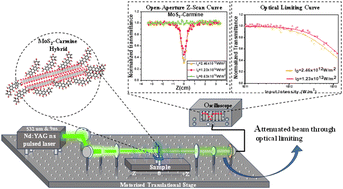
An advanced organic–inorganic hybrid material has been fabricated by combining the organic dye carmine with liquid-phase exfoliated MoS2 nanosheets, strategically utilizing their synergistic interaction for optical limiting applications. The hybrid was synthesized via a facile solution-based approach, promoting the effective adsorption of carmine molecules onto the MoS2 surface. Strong interfacial interactions between carmine and MoS2 result in enhanced and broadband optical absorption. Photoluminescence analysis reveals a marked increase in emission intensity, while time-resolved photoluminescence (TRPL) measurements show prolonged carrier lifetimes, indicating efficient interfacial charge transfer within the hybrid. Open-aperture Z-scan measurements conducted under pulsed laser excitation in the green spectral region confirm the enhanced nonlinear optical (NLO) response of the hybrid. The MoS2–carmine hybrid exhibits a significantly lower optical limiting threshold (OLT) of 1.34 × 10¹² W m−2, outperforming the individual components via the mechanism of two-photon absorption. These findings emphasize the crucial role of organic–inorganic synergy and interfacial interactions in enhancing the nonlinear optical performance, positioning this hybrid as a promising material for advanced laser protection technologies.
 Please wait while we load your content...


