


Helper lipids accelerate the mass transfer of cationic lipid nanoparticles resulting in an efficient gene delivery

Abstract
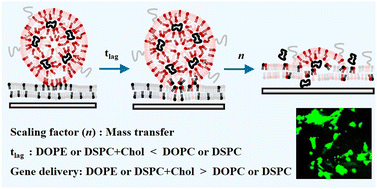
Lipid nanoparticles (LNPs) have gained significant attention because of the clinical success of the Onpattro drug and mRNA vaccines. Two major challenges remain: (i) designing LNPs for gene therapy targeting non-liver tissues and (ii) overcoming inefficient endosomal escape of conventional LNPs. Cationic LNPs have been reported to shift the organ tropism, but their endosomal escape is yet to be evaluated. Here, we investigated the fusion dynamics of cationic LNPs with model membranes at the single-particle level. We found that the membrane fusion occurs through a unique mass transfer pathway, involving a one-step transition that forms a metastable intermediate that fully coalesces with the target membrane. A moderately high concentration (31 mol%) of the cationic lipid (DOTAP), combined with either DOPE or DSPC + cholesterol helper lipids, accelerates the fusion kinetics by reducing the lag time. The enhanced fusogenicity of these compositions aligns with the bulk-phase lipid mixing results. Endosomal localization and eGFP expression upon gene delivery in a range of mammalian cell lines confirm effective endosomal escape of DOPE- or DSPC + cholesterol-rich cationic LNPs. Overall, these findings represent a step toward designing optimal cationic LNP candidates for efficient gene delivery to organs beyond the liver.
 Please wait while we load your content...


