


 PLATFORM UPDATE:


Multi-element mixing boosts exfoliation of layered hexaniobate single crystals
 *a
Kakeru
Umehara,
a
Tomohito
Sudare,
b
Kazunori
Fujisawa,
b
Hiromasa
Shiiba
b
and
Katsuya
Teshima
*abc
*a
Kakeru
Umehara,
a
Tomohito
Sudare,
b
Kazunori
Fujisawa,
b
Hiromasa
Shiiba
b
and
Katsuya
Teshima
*abc
Abstract
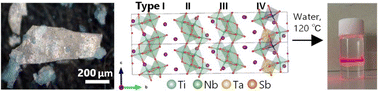
Scalable and green methods to prepare two-dimensional materials are important in the fields of catalysis, electronics, and energy conversion and storage. Existing approaches can be classified as bottom-up and top-down. Mass production through bottom-up approaches is costly, inefficient, and poorly scalable. Herein, we demonstrate a top-down approach based on chemical exfoliation. Without using strong acids or bases, single-crystalline nanosheets were obtained through hydrothermal treatment of multi-element-substituted layered oxides. Layered K4Nb6O17 single crystals with multi-element substitution were grown using a flux method. The homogeneous distribution of Ti, Ta, and Sb ions in the niobate framework was confirmed experimentally. Subsequent hydrothermal treatment caused spontaneous exfoliation to form approximately 2.3 nm-thick nanosheets. The weight-based exfoliation efficiency of single crystals after multi-element substitution was five times higher than that of pristine K4Nb6O17. Theoretical calculations revealed that substituting Nb with Ti, Ta, and Sb ions induced structural distortion in the octahedral metalate units in the K4Nb6O17 framework, facilitating spontaneous exfoliation. By mixing framework elements to exfoliate layered materials efficiently, this methodology can be used for preparing 2D ‘inks’ through solution-based fabrication techniques.
 Please wait while we load your content...


