



Progress, challenges, and opportunities in the field of biosynthetic reactions involving ambimodal transition states

Abstract
Covering: up to June 2025
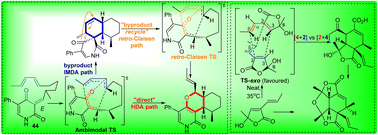
High selectivity is generally observed in the biosynthesis of complex natural molecules. Evolution usually leads to enzymes that favor the formation of a particular isomer rather than one of the many other potential molecules. Recent discoveries of enzymes with multiple sequential post-transition state bifurcations (PTSB) after ambimodal transition states demonstrate the impact of dynamics on selectivity. PTSB cause a single ambimodal transition state (TS) to form multiple products. This is different from conventional energetically-controlled mechanisms, where two discrete transition states have different energy barriers. Selectivity arising from ambimodal TSs cannot be fully explained by transition state theory. The presence of PTSB on enzyme catalyzed reaction surfaces has been discovered recently at a significantly higher rate. For both uncatalyzed and catalyzed reactions, computational chemists are devising techniques to comprehend which elements of molecular structure and vibrations govern the product selectivity in systems that contain bifurcations. This review describes enzyme-catalyzed reactions involving ambimodal transition states, and recent advances in understanding how enzymes control selectivity in such reactions.
 Please wait while we load your content...


