


 PLATFORM UPDATE:


In situ crosslinking of PEI and isocyanate for enhanced moisture resistance of ammonium dinitramide: a computational and experimental investigation
 ab
ab
Abstract
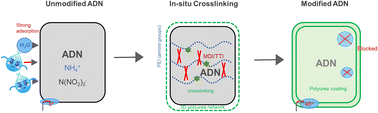
To solve the strong hygroscopicity problem of Ammonium Dinitramide (ADN), a surface coating strategy based on in situ crosslinking of polyethyleneimine (PEI) with isocyanates (MDI/TTI) was developed to enhance moisture resistance via chemical passivation and physical barrier mechanisms. A 3D polyurea network was constructed on ADN particles through a solid-phase reaction. The modified samples were characterized by ATR-FTIR, XRD, SEM-EDS, contact angle measurements, and TGA, while Monte Carlo simulations were used to elucidate the inhibition mechanism. Results show that PEI interacts with ADN via its amine groups and crosslinks with isocyanates, forming a uniform and dense coating without altering the crystal structure of ADN. The contact angle increased significantly from 5° for unmodified ADN to 45° for the ADN/PEI@TTI and ADN/PEI@MDI samples, respectively. At 25 °C and 75% RH, the moisture absorption rate decreased by over 60% within 24 h, with a reduction of up to 70% for the PEI-modified sample. TGA confirmed that thermal stability remained unchanged. Classical Monte Carlo simulation results revealed that the average saturated moisture absorption rate of the major exposed crystal faces of ADN was 14.59%, with NH4+ identified as the key moisture-absorbing site, while that of the ADN–PEI–isocyanate composite dropped significantly to 0.47–1.90%, which was in good agreement with the experimental results. This in situ crosslinking strategy has a simple process, mild reaction conditions, and significant modification effects, providing a feasible technical pathway for the practical application of ADN in high-energy solid propellants and energetic materials.
 Please wait while we load your content...


