


 PLATFORM UPDATE:


A gas-templated CeO2 nanoparticle coating with tailored defects for enhanced UV durability of PET films
 *b
*b
Abstract
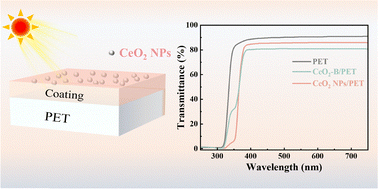
Polyethylene terephthalate (PET) suffers from photo-oxidative degradation under prolonged ultraviolet (UV) exposure, limiting its service life in packaging and outdoor applications. Although CeO2 nanoparticles (CeO2 NPs) offer efficient UV absorption, conventional synthesis methods yield severely agglomerated particles with poor dispersion, compromising both shielding efficiency and optical transparency. Herein, we report a gas-templating strategy to synthesize well-dispersed CeO2 NPs with a uniform size (∼10.8 nm) and a high specific surface area (109.2 m2 g−1). Spectroscopic analyses reveal that CeO2 NPs possess a narrower optical bandgap, a higher Ce3+/Ce4+ ratio, and a higher concentration of surface oxygen vacancies than conventionally prepared bulk CeO2, collectively enhancing UV absorption. When incorporated into a UV-curable coating on PET films, the CeO2 NPs coating achieves a broad UV cutoff approaching approximately 360 nm while maintaining high visible transparency (∼86%). The coated film exhibits excellent UV durability with negligible transmittance change after 100 h of continuous irradiation and enhanced scratch resistance. This work establishes a facile strategy for high-performance UV-blocking coatings, extending PET durability in demanding applications.
 Please wait while we load your content...


