


 PLATFORM UPDATE:


Systematic theoretical investigation of Li5NbWO8 as a novel solid electrolyte via first-principles calculations

Abstract
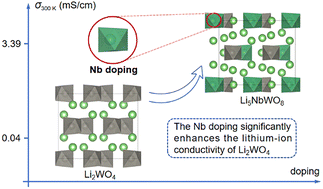
Through systematic first-principles calculations combined with thermodynamic analysis and molecular dynamics simulations, this study provides an in-depth exploration of the potential of a novel lithium–niobium–tungsten oxide, Li5NbWO8, as a “multi-functional integrated” solid electrolyte. The work confirms that this material possesses excellent thermodynamic stability and a high oxidation limit (∼3.61 V vs. Li+/Li), which is significantly superior to that of the classic garnet electrolyte LLZO (∼2.9 V). The calculation results demonstrate that Li5NbWO8 exhibits exceptional lithium-ion conduction performance, with a predicted room-temperature ionic conductivity of 3.39 mS cm−1 and an activation energy of 0.26 eV. At the microscopic level, the lithium-ion transport is revealed to originate from the concerted migration mechanism and optimized three-dimensional diffusion channels introduced by Nb doping at the W site. Further interfacial thermodynamic analysis indicates that the material shows good chemical compatibility with high-voltage layered oxide cathodes (e.g., LiCoO2 and LiNiO2) across a wide range of states of charge. This is attributed to its unique design of a “highest-valence cation framework coupled with a lithium-rich matrix,” which effectively suppresses interfacial side reactions. This work elucidates, at the atomic scale, the critical role of the “niobium–tungsten synergistic effect” in enhancing both ionic conductivity and interfacial stability, thereby providing a new material design concept and theoretical foundation for the development of high-performance solid electrolytes aimed at high-energy-density all-solid-state batteries.
 Please wait while we load your content...


