


Constructing a gradient lithiophilic structure within a 3D stable framework for a dendrite-free lithium metal anode
 *a
Ming
Chen
*ad
*a
Ming
Chen
*ad
Abstract
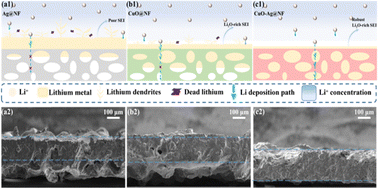
This study proposes a gradient lithiophilic structure (CuO–Ag@NF) constructed on nickel foam (NF) to achieve dendrite-free lithium metal anodes. The framework was fabricated through replacement reaction-deposited nano-silver (Ag@NF), and an electrochemically deposited copper layer (Cu–Ag@NF), followed by calcining to yield CuO–Ag@NF. Density functional theory calculations demonstrate that the gradient architecture of CuO–Ag@NF significantly enhances lithium adsorption energy (−4.26 eV) relative to single-component systems (CuO@NF: −3.72 eV; Ag@NF: −2.46 eV), concurrently homogenizing the electric field distribution and reducing the nucleation overpotential to 36.5 mV. Electrochemical validation confirms exceptional performance, with half-cells achieving 450 cycles at 1 mA cm−2/1 mAh cm−2 (99.5% Coulombic efficiency), symmetric cells maintaining stable operation for 1650 h at 1 mA cm−2/1 mAh cm−2 (15 mV polarization), and LiFePO4 full cells retaining 95.3% capacity after 400 cycles at 1C. Structural characterization reveals that the gradient structure promotes uniform deep lithium deposition while suppressing the formation of dendrites and dead Li. This work provides a viable strategy toward high-safety, long-life lithium metal batteries.
 Please wait while we load your content...


