


Advanced surface functionalization strategies for nanofibers in biomedical applications

Abstract
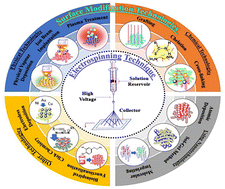
Electrospun nanofibers have emerged as a versatile platform in biomedical applications, including tissue engineering, wound healing, drug delivery, dental regeneration, bone and cartilage repair, and cancer therapy. Their high surface-area-to-volume ratio, tunable porosity, and ability to mimic the extracellular matrix (ECM) make them ideal scaffolds for supporting cell adhesion, proliferation, and differentiation. Functionalization with bioactive molecules, growth factors (BMP-2, TGF-β3, VEGF), hyaluronic acid, and nanoparticles further enhances their therapeutic potential, enabling targeted and sustained drug delivery and enhanced tissue regeneration. Notably, BMP-2 functionalized nano-hydroxyapatite scaffolds can promote cranial bone repair, while nanofiber scaffolds can accelerate articular cartilage regeneration. Coaxial electrospun fibers have recently shown promising results in localized anticancer drug delivery, improving efficacy while reducing systemic toxicity. The novelty of this review lies in systematically evaluating the effects of surface functionalization of electrospun nanofibers in composite scaffold designs on drug delivery, tissue regeneration, and cancer therapy applications. By integrating strategies such as BMP-2 or hyaluronic acid functionalization, coaxial electrospinning, and 3D printing, the scaffolds simultaneously achieve improved mechanical integrity, controlled bioactive factor release, and ECM-mimicking structural features. This approach bridges materials science and biomedicine, providing a comprehensive framework for designing multifunctional nanofiber scaffolds capable of supporting bone, cartilage, dental, and soft tissue regeneration, as well as localized therapeutic delivery, thereby offering novel solutions for next-generation biomedical applications.
 Please wait while we load your content...


