


 PLATFORM UPDATE:

Size control of NiO nanoparticles for hydrogen storage application

Abstract
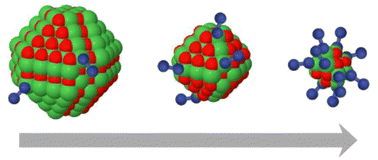
The development of highly efficient H2 storage materials is fundamental for the realisation of a H2-based economy in the future. In this regard, NiO nanoparticles with controlled size were synthesized through a low-complexity route to investigate the influence of the NiO nanoparticles’ size on the H2 storage under mild conditions. The NiO nanoparticles presented mean sizes ranging from 13 to 32 nm that increase linearly with the calcination temperature used in the synthesis. The H2 adsorption measurements of 1 wt% NiO/C nanoparticles showed an enhanced gravimetric capacity at room temperature and atmospheric pressure as compared to Ni-based systems under non-mild conditions in the literature. The NiO/C nanoparticles presented a clear linear dependence of the gravimetric capacity on the nanoparticles’ mean size, where smaller NiO nanoparticles yielded higher H2 uptake, reaching 0.40 wt% for NiO/C nanoparticles of 13 nm mean size. Spin-polarized density functional theory (DFT+U) calculations of NiO clusters showed that H2 adsorption is strongly site-dependent, preferentially occurring on Ni sites. Low-coordination Ni vertex sites provide adsorption energies at the border between quasi-molecular bonding and chemisorption regimes and enable the dissociation of the H2 molecule, thus supporting a spillover-assisted storage mechanism. The higher fractional abundance of these vertex sites in smaller NiO nanoparticles explains the experimentally observed size–capacity trend and highlights nanoparticles’ size control as an effective pathway to optimize the H2 storage at ambient conditions.
- This article is part of the themed collection: Articles behind the 2026 journal covers
 Please wait while we load your content...


