


Electrolyte engineering enables rechargeable nonaqueous aluminum–sulfur batteries
 *a
*a
Abstract
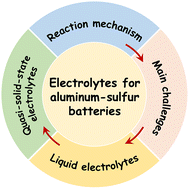
Rechargeable aluminum–sulfur batteries, coupling low-cost, high-capacity aluminum metal anodes and sulfur cathodes, are promising candidates for next-generation energy storage devices but face persistent challenges of fast capacity fading and low energy efficiency. In this perspective, we discuss electrolyte-centered strategies to overcome these bottlenecks, uncovering the importance of electrolyte engineering in the development of high-performance Al–S batteries. It first introduces the two established reaction mechanisms, S0/S2− and S0/S+, and analyzes how sluggish ion transport, polysulfide or sulfur-chloride shuttling, and slow Al3+ desolvation lead to performance losses. Then, advances in ionic liquid electrolytes, deep eutectic liquid electrolytes, inorganic molten salt electrolytes, and quasi-solid-state systems are presented, highlighting their roles in enhancing desolvation, improving ionic transport, and suppressing shuttle effects. Future research directions including rational tuning of ionic species, development of chemically compatible non-ionic components, and a deeper mechanistic understanding of sulfur redox chemistry, ion transport, and desolvation are emphasized to guide the design of electrolytes for practical Al–S batteries.
 Please wait while we load your content...


