


Lattice-engineered asymmetric Mn–O–Ru motifs with bridge oxygen vacancies for efficient acidic water oxidation

Abstract
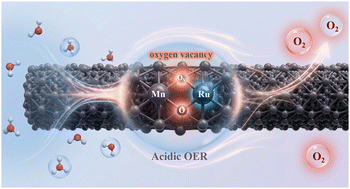
Proton exchange membrane electrolysers require oxygen evolution catalysts that are both highly active and durable in strongly acidic media, yet state-of-the-art noble-metal oxides remain constrained by cost and corrosion. Here we report a lattice-engineering strategy that overcomes this activity–stability trade-off by anchoring ruthenium within an α-MnO2 nanowire scaffold. Using a morphology-controlled ion-exchange approach, we construct asymmetric Mn–oxygen vacancy-Ru motifs that leverage strong metal support interactions. We demonstrate that the one-dimensional nanowire architecture stabilizes a high density of oxygen vacancies and frustrated Lewis pairs while maintaining ruthenium in a low-valence state, effectively buffering against lattice over-oxidation and dissolution. Consequently, the optimized catalyst achieves an ultralow overpotential of 179 mV at 10 mA cm−2, with a Tafel slope of 47.2 mV dec−1 and a mass activity of 1536 A gRu−1 at 270 mV overpotential–approximately 80 times higher than commercial RuO2. Furthermore, the system exhibits exceptional durability, sustaining operation for 920 hours with negligible voltage decay. These findings elucidate that introducing well-defined oxygen vacancies and asymmetric heterometal–oxygen motifs can accelerate key deprotonation steps and, importantly, suppress pathways leading to over-oxidation and dissolution of Ru under acidic OER.
 Please wait while we load your content...


