


Hierarchical holey reduced graphene oxide–carbon quantum dot hybrid conductive additives enabling high-rate and long cycle life LiFePO4 cathodes
 *a
and
*a
and
Abstract
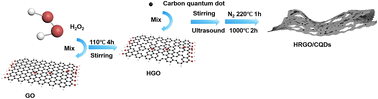
LiFePO4 has been widely commercialized due to its long cycle life, excellent safety performance, and high operating voltage. However, its low electronic conductivity (10−9–10−10 S cm−1) and slow lithium-ion diffusion rate (∼10−14 cm2 s−1) lead to capacity decay, limiting its application in electric vehicles. This study focuses on addressing the issues of low electrical conductivity and capacity decay in LiFePO4. It proposes a multi-level conductive network construction strategy: utilizing holey graphene as a two-dimensional conductive framework combined with the interfacial modification effect of carbon quantum dots to synergistically optimize the electron/ion transport efficiency of LiFePO4 electrodes. Experimental results demonstrate that with a minimal addition of 2 wt% prepared composite to the LiFePO4 system, the cycling stability is significantly improved. At a current rate of 0.1C, the discharge specific capacity reached 159 mAh g−1. Even when the current rate was further increased to 3C, the discharge specific capacity remained at 100 mAh g−1. Its discharge specific capacity achieved 134 mAh g−1 at a current rate of 1C. After 300 cycles, the capacity retention rate remained at 80%. This superior performance is primarily attributed to the synergistic effect provided by the composite structure of holey reduced graphene oxide (HRGO) and carbon quantum dots (CQDs). This demonstrates that the HRGO-CQD composite conductive agent holds promise as a candidate for novel conductive materials and opens a new pathway for enhancing the performance of lithium iron phosphate batteries.
 Please wait while we load your content...


