


Novel quinoline-fused quinolone derivatives: synthesis, photophysical studies, solvatochromism and chemosensing applications toward Cu2+, Fe3+, and Hg2+ ions
 †a
Shantanu
Pal
*a
†a
Shantanu
Pal
*a
Abstract
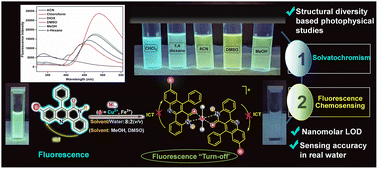
A series of novel quinoline-fused quinolone-based fluorescent probes have been designed and synthesized via Zn-catalysed one-pot aerobic oxidative annulation reactions using o-vinylaniline and isatin derivatives as starting materials. The photophysical studies of the synthesized molecules revealed a positive fluorescent solvatochromism with moderate to excellent quantum yields (ΦF = 0.024–0.695) and large Stokes shifts (6520–13 783 cm−1). Probes 5e and 6 exhibited a fluorescence “Turn-Off” response upon binding with Fe3+, Cu2+, and Hg2+, displaying strong selectivity over other metal ions. The detection limits of probe 6 were 52.5 nM (for Cu2+, linearity 8–28 µM), 34.88 nM (for Fe3+, linearity 6–30 µM) and 16.5 nM (for Hg2+, linearity 2–10 µM), well below or comparable to the USEPA standards for drinking water. Mechanistic studies including Job's plot, 1H and 13C NMR titrations, IR, HRMS analyses, DFT and TCSPC studies confirmed a 1 : 2 metal–ligand complex formation in which Cu2+/Fe3+ ions coordinate with the amide (–CONH–) group, suppressing intramolecular charge transfer (ICT) within the donor–π–acceptor (D–π–A) system, leading to fluorescence quenching. The sensor's practical applicability was demonstrated in real water samples (accuracy rate of 100 ± 4%) and in the development of encryption ink.
 Please wait while we load your content...


