


Catalytic hydrogenation of carbon dioxide to methanol by homogenous ruthenium(ii) hydrido carbonyl complexes

Abstract
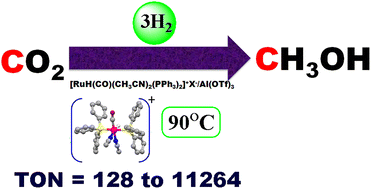
Ruthenium(II) hydrido carbonyl complexes, namely, [RuH(CO)(CH3CN)2(PPh3)2]+X− [X = BF4 (1) and PF6 (2)], were synthesized and characterized spectroscopically. The molecular structure of 2 was determined by the single-crystal X-ray diffraction technique. The structure study of 2 revealed that it is a mononuclear complex with a ruthenium centre and distorted octahedral geometry. These complexes were used as catalysts towards the catalytic hydrogenation of CO2 to methanol at 90 °C in an integrated one-pot system, where methanol was obtained in high yields in acidic media. Among the two ruthenium-based catalysts, 1 showed superior catalytic performance over 2 owing to the varying proton-accepting abilities of their counterions, which also affected the catalytic rate. Thus, its superior catalytic performance makes [RuH(CO)(PPh3)2(CH3CN)2]BF4 a potential candidate for realizing the large-scale production of methanol by CO2 hydrogenation. We also conclude that for the scalable conversion of CO2 to methanol, aluminum tris(trifluoromethanesulfonate) acid results in the highest catalytic activity when compared with other acids.
 Please wait while we load your content...


